Q u a d r i l a t e r a l s
Scroll to the bottom for a listing of
properties for all types of quadrilaterals
| |
|
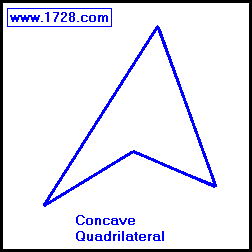 A quadrilateral is a geometric figure having four sides and four angles which always total 360°. A quadrilateral is a geometric figure having four sides and four angles which always total 360°.
We will discuss all types of quadrilaterals except the concave quadrilateral. (See diagram).
This type of quadrilateral has one angle greater than 180°. (Angles greater than 180° are called concave angles). These quadrilaterals
are not discussed much in a typical geometry course and are not among the quadrilaterals with which you are familiar.
Generally, all a quadrilateral needs to be classified as such is four sides. However, there are six specific quadrilaterals that are worth discussing
in detail.
Trapezoids
Click here for a trapezoid calculator.
First, it is important to state the difference in definitions between British and American usage.
The British use the term trapezoid to refer to a
quadrilateral with no parallel sides and a trapezium is a quadrilateral with two parallel sides.
The American usage is the exact opposite of the British usage: trapezoid -
two parallel sides trapezium - no parallel sides.
The only requirement for a trapezoid (American definition) is that two sides are parallel.
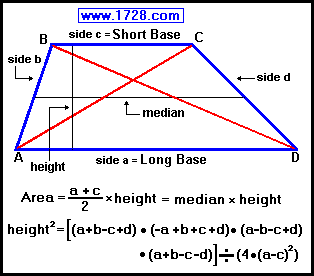 Side a and side c are the parallel sides and are called bases.
The non-parallel sides (side b and side d) are called legs.
Lines AC and BD are the diagonals.
The median is perpendicular to the height and bisects lines AB and CD.
∠ A plus ∠ B = 180° ∠ C plus ∠ D = 180°
Trapezoid Area = ½ • (sum of the parallel sides) • height
height² = [(a +b -c +d) • (-a +b +c +d) • (a -b -c +d) • (a +b -c -d)] ÷ (4 • (a -c)²)
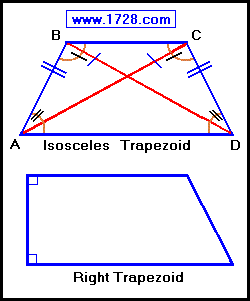 Two special cases of trapezoid are worth mentioning.
The legs and diagonals of an isosceles trapezoid are equal.
AB = CD and AC = BD
Both pairs of base angles are equal
∠ A = ∠ D and ∠ B = ∠ C
The right trapezoid has two right angles.
Kites
Click here for a kite calculator.
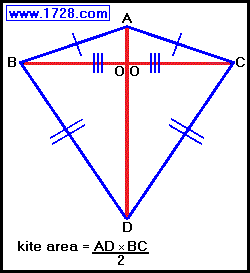 ∠ A and ∠ D are vertex angles
∠ B = ∠ C and are the non-vertex angles
Lines AD and BC are diagonals and always meet at right angles.
Diagonal AD is the axis of symmetry and bisects diagonal BC, bisects ∠ A and ∠ D,
and bisects the kite into two congruent, triangles. (△ ABD and △ ACD)
Diagonal BC bisects the kite into two isosceles triangles. (△ ABC and △ BCD)
Side AB = side AC, side BD = side CD and Line OB = Line OC
Parallelograms
Click here for a parallelogram calculator.
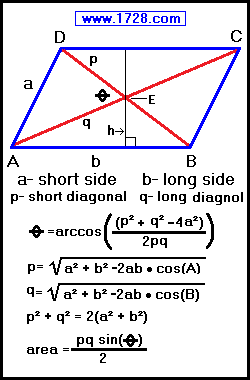 • Both pairs of opposite sides are equal. (Side AD = BC Side AB = DC)
• Both pairs of opposite angles are equal (∠ A = ∠ C ∠ D = ∠ B)
• Diagonals bisect each other. AE = EC DE = EB
• Each diagonal forms two congruent triangles.
Diagonal AC forms △ ADC and △ ABC
Diagonal DB forms △ DCB and △ DAB
• Diagonals are not equal.
• Diagonals do not bisect the vertex angles.
• Area = side b • height or area = Line AB • height
• Angle A = arc sine (height ÷ side a)
• Angle A = arc cosine (side a² + side b² -p²) ÷ (2 • side a • side b)
• Angle B = (180° -Angle A)
• Side a = Square Root [ (p² + q² -2b²) / 2 ]
• Side b = Square Root [ (p² + q² -2a²) / 2 ]
• Height = side a • sine (A)
• Perimeter = 2 • (side a + side b)
Rhombuses
Click here for a rhombus calculator.
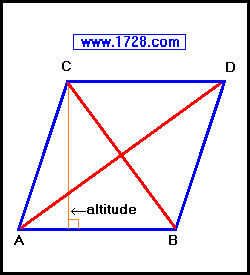 • All four sides are equal (Side AB = BD = DC = CA)
• Diagonals meet at right angles
• Diagonals bisect each other
• Diagonals bisect the vertex angles ∠ A ∠ B ∠ C and ∠ D
• Both pairs of opposite angles are equal
∠ A = ∠ D ∠ C = ∠ B
• Adjacent angles are supplementary (they sum to 180°)
∠ A + ∠ B = ∠ B + ∠ D = ∠ D + ∠ C = ∠ C + ∠ A = 180°
• Rhombus Altitude = side • sine (either angle) = (AD • CB) ÷ (2 • side)
• Rhombus Area = (AD × CB) ÷ 2 = side • altitude = side² • sine (either angle)
• Long Diagonal AD = Side Length • Square Root [ 2 + 2 • cos(A) ]
• Short Diagonal BC = Side Length • Square Root [ 2 + 2 • cos(B) ]
• 4 • Side² = Long Diagonal² + Short Diagonal²
Rectangles
Click here for a rectangle and square calculator.
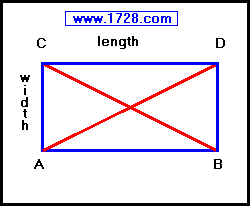 • Opposite sides are parallel and equal
• All 4 angles are right angles
• Diagonals bisect each other and are equal
• Rectangle Area = length × width
• Perimeter = (2 × length) + (2 × width)
Squares
Click here for a rectangle and square calculator.
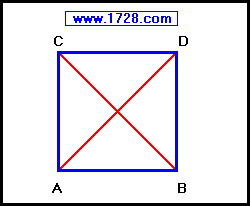 • All 4 sides are equal
• All 4 angles are right angles
• Diagonals bisect each other at right angles and are equal
• Perimeter = 4 × side length
• Area = (side length)2
Quadrilateral Properties
|
| | D I A G O N A L S | Isosceles
Trapezoid | Kite | Parallel
ogram | Rhombus | Rectangle | Square |
| Diagonals Bisect Each Other | | | Y E S | Y E S | Y E S | Y E S |
| Diagonals Are Equal | Y E S | | | | Y E S | Y E S |
| Diagonals Meet At Right Angles | | Y E S | | Y E S | | Y E S |
| P A R A L L E L S I D E S | Isosceles
Trapezoid | Kite | Parallel
ogram | Rhombus | Rectangle | Square |
| Only 2 Sides Are Parallel | Y E S | | | | | |
| No Sides Are Parallel | | Y E S | | | | |
| Both Pairs of Opposite Sides Are Parallel | | | Y E S | Y E S | Y E S | Y E S |
| E Q U A L S I D E S | Isosceles
Trapezoid | Kite | Parallel
ogram | Rhombus | Rectangle | Square |
| Only 2 Sides Are Equal | Y E S | | | | | |
Both Pair of Adjacent Sides Are Equal
But No Opposite Sides Are Equal | | Y E S | | | | |
| Both Pair of Opposite Sides Are Equal | | | Y E S | Y E S | Y E S | Y E S |
| All Four Sides Are Equal | | | | Y E S | | Y E S |
| A N G L E S | Isosceles
Trapezoid | Kite | Parallel
ogram | Rhombus | Rectangle | Square |
| Both Pairs of Base Angles Are Equal | Y E S | | | | | |
| Non-Vertex Angles Are Equal | | Y E S | | | | |
| Only Opposite Angle Pairs Are Equal | | | Y E S | Y E S | | |
| All Four Angles Are Right Angles | | | | | Y E S | Y E S |
| O T H E R | Isosceles
Trapezoid | Kite | Parallel
ogram | Rhombus | Rectangle | Square |
| Cyclic Quadrilateral | Y E S | | | | YES | YES |
| Tangential Quadrilateral | | YES | | YES | | YES |
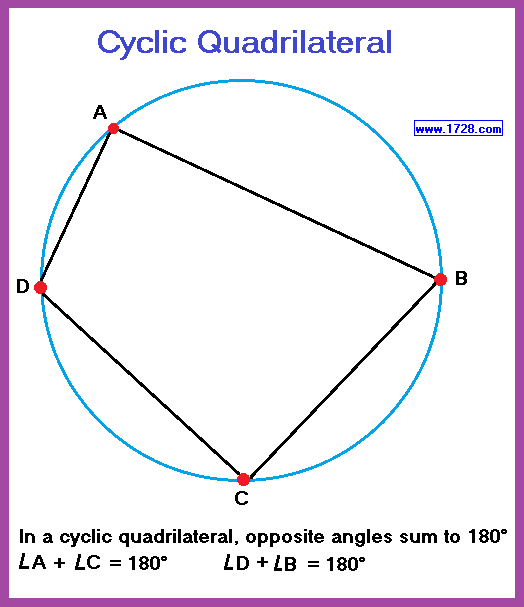
A circle can be circumscribed around a cyclic quadrilateral and its opposite angles add up to 180°
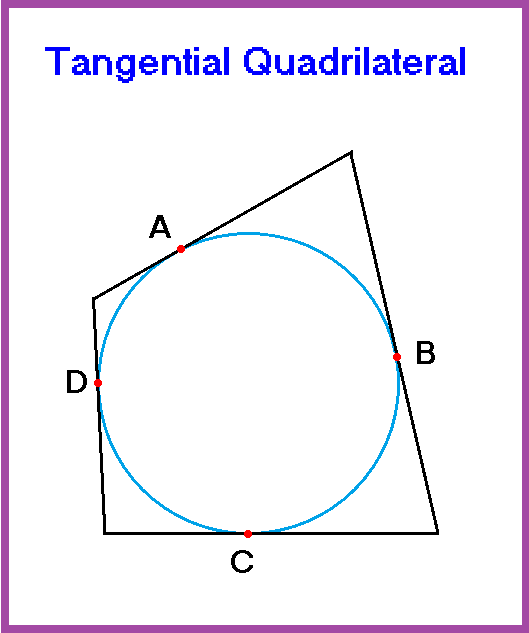
A circle can be inscribed inside a tangential quadrilateral.
Return To Home Page
Copyright © 2000 1728 Software Systems
|