|
First, let's briefly discuss solving quadratic equations using a method called:
Completing The Square
Let's see what a typical
perfect square
looks like.
(X + n)² = X² + 2nx + n²
Note the rightmost term (n²) is related
to 2n (the x coefficient) by the formula:
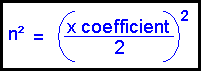
(This will become apparent when you
see Step 3 below)
| |
Now, let's choose an example Quadratic Equation:
4X² + 12X -16 = 0
Solving this by "completing the square" is as follows:
1) Move the "non X" term to the right:
4X² + 12X = 16
2) Divide the equation by the coefficient of X² which in this case is 4
X² + 3X = 4
3)
Now here's the "completing the square" stage in which we:
• take the coefficient of X
• divide it by 2
• square that number
• then add it to both sides of the
equation.
|
| |
In our sample problem
the coefficient of X is 3
dividing this by 2 equals 1.5
squaring this number equals (1.5)² = 2.25
Now, adding that to both sides of the equation, we have:
X² + 3X + 2.25 = 4 + 2.25
4) Finally, we can take the square root of both sides of the
equation and we have:
X + 1.5 = Square Root (4 + 2.25)
X = Square Root (6.25) -1.5
X = 2.5 -1.5
X = 1.0
Let's not forget that the other square root of 6.25 is -2.5 and so the
other root of the equation is:
(-2.5 -1.5) = -4
The Quadratic Formula
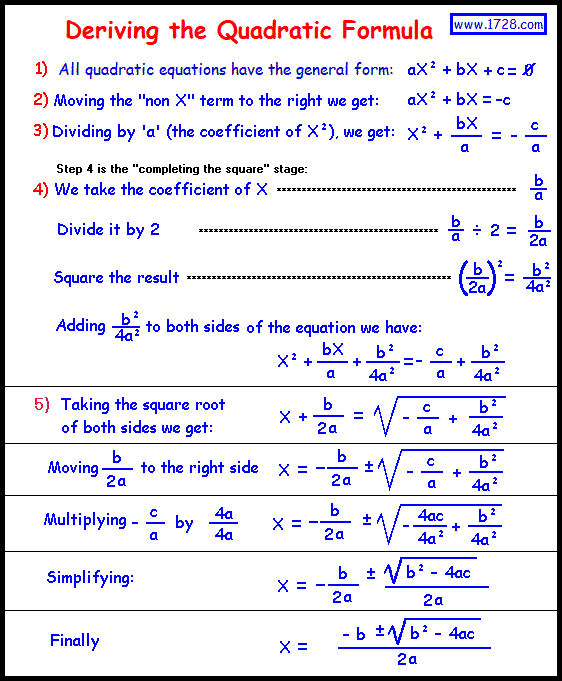
We can follow precisely the same procedure as above to derive the
Quadratic Formula.
RETURN TO QUADRATIC EQUATION CALCULATOR
|